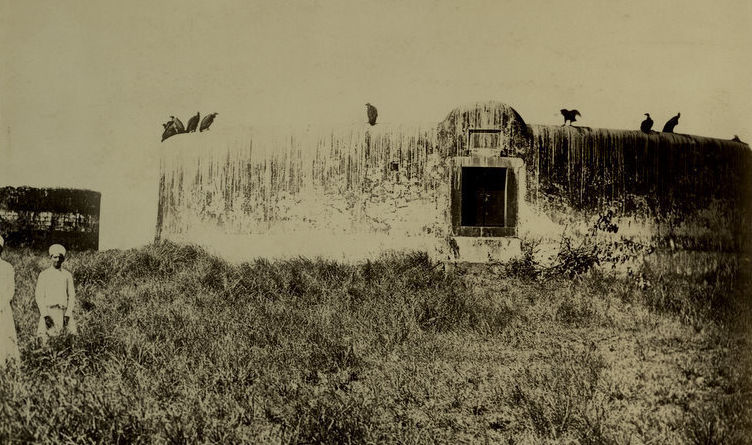
“High above Mumbai’s streets, the Parsis return their dead to the sky.”
In Bombay, I sometimes watched from my balcony of my small hotel, as on certain mornings, large, dark, birds began to circle and cluster on a nearby rooftop. At first it seemed an odd sort of bird gathering, but I soon learned the reason: they were vultures, and their sudden congregation signalled the arrival of a new corpse at the “Tower of Silence.”

This structure, stark and circular, is used for the funeral rites of the Parsis, followers of Zoroastrianism — one of the world’s oldest religions, stretching back to ancient Persia. In its traditions, the dead are laid out in the open at the top of the tower, unclothed, for vultures and other scavenger birds to strip away the flesh. It is considered both a practical and spiritually pure way to give the body to nature. It doesn’t contaminate the elements of earth, fire, or water. Once the bones are bare, they are buried.
The Parsis themselves form a small but influential community in India, known for their prominence in business, finance, and the arts. They have given the country industrial pioneers, philanthropists, and musicians — including Freddie Mercury, the singer with Queen, who was born Farrokh Bulsara to Parsi parents. From my balcony, the sight was at once strange and oddly matter-of-fact. Life in Bombay was going on, with ancient rituals taking place unoticed above the city’s busy streets.
Another day, nearby, I saw another happening I didn’t understand. This is one of the reasons I travel, to understand different ways of living and doing things.
An old woman was walking along the street using a twig brush to clean the path in front as she walked. I thought to myself, “This is a little bizarre”. I imagined an obsesssion with cleanliness on a dirty street.
But no! The hotel manager explained that there was a Jain temple nearby and she was undoubtedly a member. Strict Jains carry a ‘rajoharan’, a small broom made of peacock feathers or fine twigs. They sweep the ground before each step to avoid harming, any living organism that might be crushed: tiny insects – ants for example – and even seeds.
For Jains, harming even a tiny creature creates bad karma. Sweeping the path is a way of walking through the world with awareness of all living things.
I agree with the idea of Karma but wasn’t this way of living more than difficult, even impossible? I was, however, informed that mostly only older members follow this strict interpretation – those waiting for the final bell!
There are about 6 million Jains worldwide with 5 million of them in India. About 500,000 off hem live in Bombay (Mumbai). The old lady was one in 6 million.
