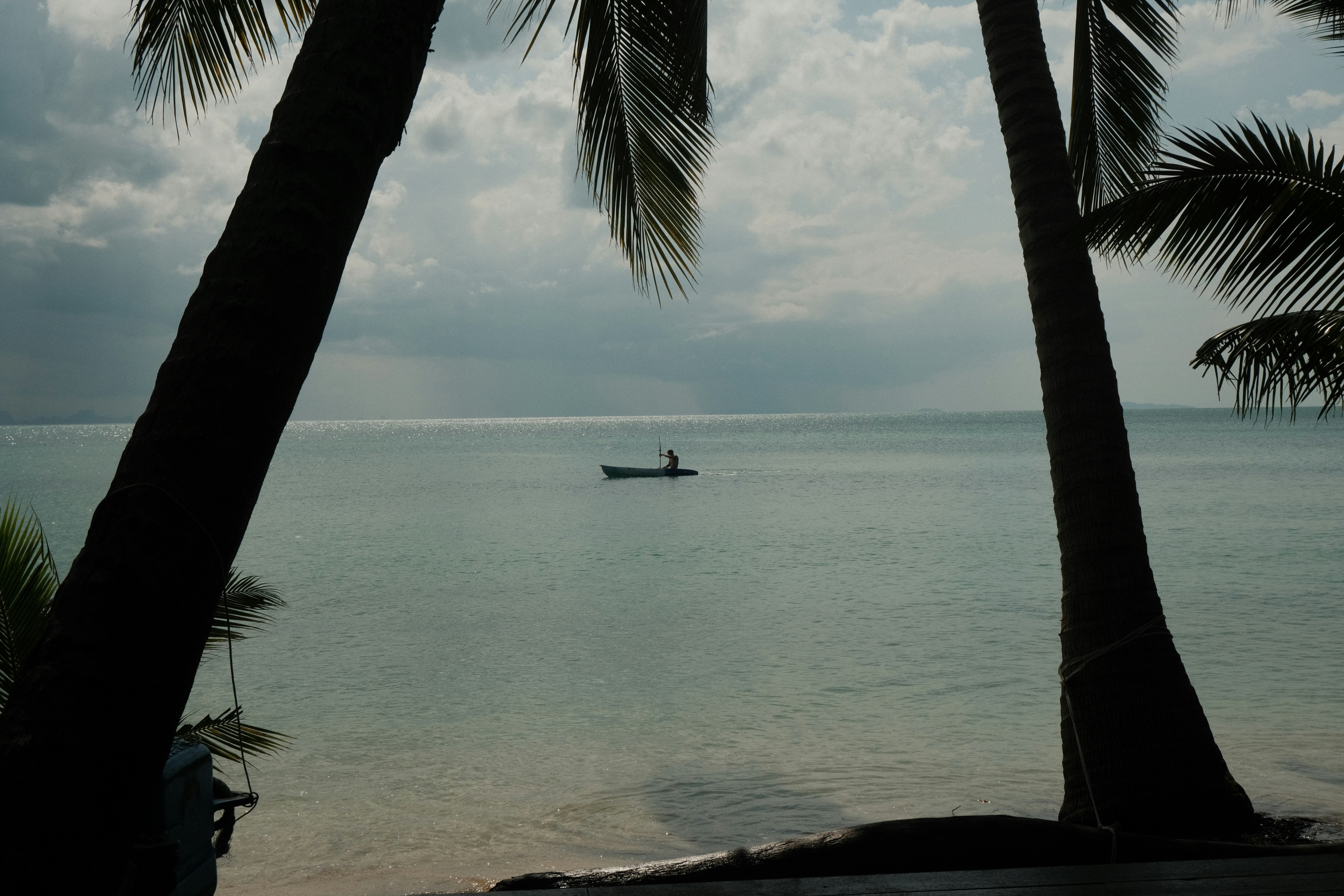

Before the Crowds Came
Gorgeous, Chilled-Out Koh Samui (Photo Credit)
The Chao Phraya River was brown and running fast toward the Gulf of Thailand. I had been told where and when to catch the small cargo boat heading from Klong Toei port to Koh Samui, and with the turning tide we set off.
For hours I watched life along the river as we made our way to open sea. The boat carried building materials south and would return with copra and whole coconuts; the island sent millions each month. I slept on deck—the only option—and ate the same rice dishes as the five-man crew. I was the lone passenger on the three-day trip.
Having recently arrived, I spoke no Thai, and the crew often shot me curious looks. A foreigner choosing a cargo boat over the train must have seemed odd. The idea that Joseph Conrad had sailed those waters may have been part of the attraction; being broke certainly was. Out of sight of land, the crew sat cross-legged listening to Thai music on a tiny radio. At first it grated on me, then eventually became part of the rhythm of the 3-day trip.
After roughly 700 km we tied up at a wooden pier. Nearby stood the island’s one hotel: a simple, one-storey wooden building on stilts with a tin roof, a handful of rooms, and a communal bathroom with a squat toilet and a huge jar of water. A lively, skeletal-thin Chinese woman ran it with her two children; her husband worked in Bangkok. A second “hotel,” a 3-storey, concrete block doubling as the local brothel, catered mainly to boat crews without island families.
In 1973 there were no organised activities on Koh Samui; a few backpackers appeared now and again, but the island felt outside time. My mornings began with a bowl of bird-egg noodle soup in a tiny straw-roofed restaurant nearby -the hotel did not have one. I lingered with my bare feet in the sand, watching trained monkeys on long leads knock down coconuts for shipment to Bangkok.
In the afternoons I sometimes rode a songthaew to Lamai Beach. I rarely saw more than half a dozen people on the long, coconut-fringed curve of sand. The rough road linking Nathon to Lamai had only been completed; before that, the 20 km walk across jungle and hills made day-trips impossible. Lamai felt like the untouched beaches you see only in postcards.
I went frequently, maybe twice a year (school holidays) and became friends with one of the ferry – Surat Thani to Koh Samui – captains, a fat, jolly, smiling man about my age. He slept a few hours after his night trip and, sometimes, in the afternoon, he took the boat out a little way to fish and brought me along. We would drop the lines in the water, have a couple of beers and amuse ourselves. What we caught the hotel cooked for us and we ate on the pier and drink Mekong. Then the captain slept an hour or two and readied the ferry for the night sail.

The ferry was a top- heavy, flat-bottomed floating danger. A couple of times I was really scared when storms caught us on the way. I remember several accidents and shortly after I left one ferry went down in a storm with heavy loss of life. I never discovered the name of the boat.
Remote places, even paradises, can have their problems. One day a German backpacker I recognised hobbled past me on the street in Nathon with a bandaged leg. He had been shot on Lamai. He and his girlfriend had been sleeping on the beach when a man appeared, shouted, and fired at him as he raised his legs to defend himself. Nothing was stolen; his only theory was that their nude swimming earlier had offended.
On a later visit I was swimming near the rocks with a small group of backpackers when two Thais approached. One asked for money. When we said we had only enough for the songthaew, the second man quietly opened his shirt to reveal a pistol. He didn’t draw it. He simply watched as his companion checked our bags and walked off with a camera, a watch and a few notes. There was nothing much to take; nobody brought money to Lamai, there was nothing to spend it on. We stood around in silence, a little shocked for a while—paradise cracked but not broken.
I fell in love with the island and its leisurely way of life. It stayed in my heart long after I left Thailand. I promised myself, the night I left, that I would go back one day, and I did.
I went back, many years later. I knew it had changed but not how much. I wrote about the “Going Back” in another piece.