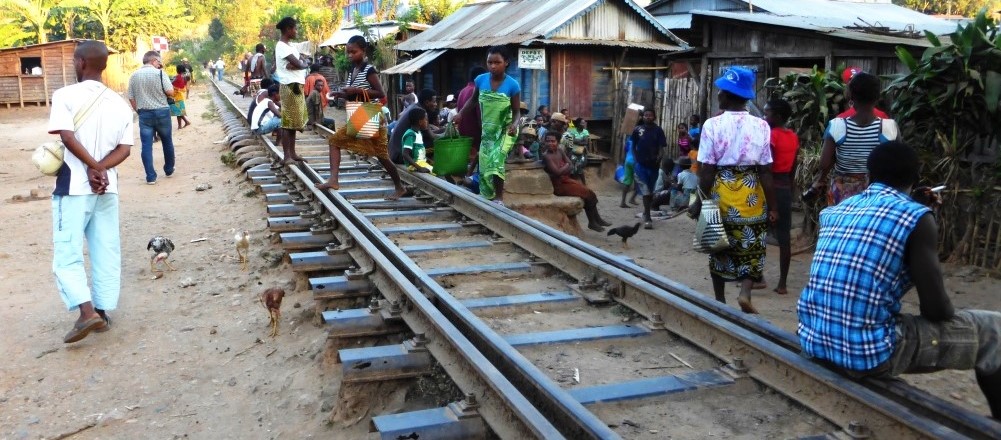

There are burdens resting on the red, delicate diesel shoulders of the old train. It has been given many roles to play, even though it is dilapidated, feeble, cranky, and wildly unpredictable. Yet it should not be judged by appearance or performance alone.
This is the last passenger train still running in Madagascar, linking the highland town of Fianarasoa to the east coast town of Manakara — when it runs. Today, we will take fourteen hours to cover 163 kilometres, sometimes, it takes much longer. The rails, battered over the years by cyclones, mudslides, and time itself, should be treated gently.

It is 7 a.m., the appointed time on the timetable, and the train should be flexing its muscles, chugging into motion. But all is quiet. The ticket office remains shuttered; lesson learned: time is not master here.
The train carries history in its bones. Many of the rails it runs on date from the late 19th century — part of the reparations seized by the French from the Germans after World War I. Becoming financially dependent on offbeat tourists must seem a comedown for a venerable lady with such an impressive CV.

We are about to cross 68 bridges, pass through 40 tunnels, make 18 scheduled stops — and a few unscheduled ones. The train shudders to halts, skips and jolts forward, sometimes in what feels like a metallic hip-hop dance, sometimes as if sighing with guilt over the forced labour used to lay the rails.
There are four first-class carriages — vinyl seats, battered and torn — priced beyond most locals’ pockets. Up front, two goods wagons are crammed with cargo and passengers alike.
First class is almost entirely white: mainly retired French tourists, cameras and video recorders at the ready. They chase from side to side of the carriage, capturing sweeping views of coffee fields, rice paddies, banana plantations, sugar cane, towering mountains, winding rivers, and village life. They spill out at tiny station platforms, lenses aimed at giggling children, anxious vendors, and piles of local produce.

All doors and windows are open — few can actually close. No warning signs here: arms, legs, heads hang out freely, though at some risk. Thick vegetation rubs and snaps against the carriages; a slap from a banana leaf or a thornier branch is a real possibility – I know.

The train’s arrival at each village is an event. Children skip and dance. Women, trays balanced on heads, crowd the platform selling fried snacks and fruits. Competition is fierce. Across a huge gulf of difference, the two worlds touch lightly: a French lady tries a new Malagasy phrase with some barefoot children, provoking hilarity. A German man shuffles awkwardly into a children’s dance. A young Frenchman leads a group of kids in a Malagasy song he has learned. Curious snacks with strange names are sampled — little bridges across a deep divide.

At a stop I chat chat with the driver. He smells of rum. Three French girls with bright smiles ask to ride in the driver’s cabin. He refuses, apologetically — his boss is aboard. At a shack by the tracks, I buy him a small bottle of local rum. At our speed, derailment feels unlikely.
The driver sits with us on some rusty signalling equipment and knocks down a large jackfruit with a stone. A wizened old man with a soiled cap slices it open with a machete and shows us how to eat it. The French girls taste the rubbery flesh for the first time.
A family of geese marches through the station and onto the bustling platform without turning a single head.
As dusk falls, vacant seats in first class fill with locals. People share benches and floors. The two worlds mingle a little more, squeezed together by the falling dark.
At last, in a darkened town, rickshaws wait to ferry passengers into the night. The two worlds — having touched briefly and lightly — separate again. The old engine rests at the front, job done. If it hadn’t been so dark, and if my bag hadn’t already been whisked away by a rickshaw driver, I might have gone forward to say thank you.
