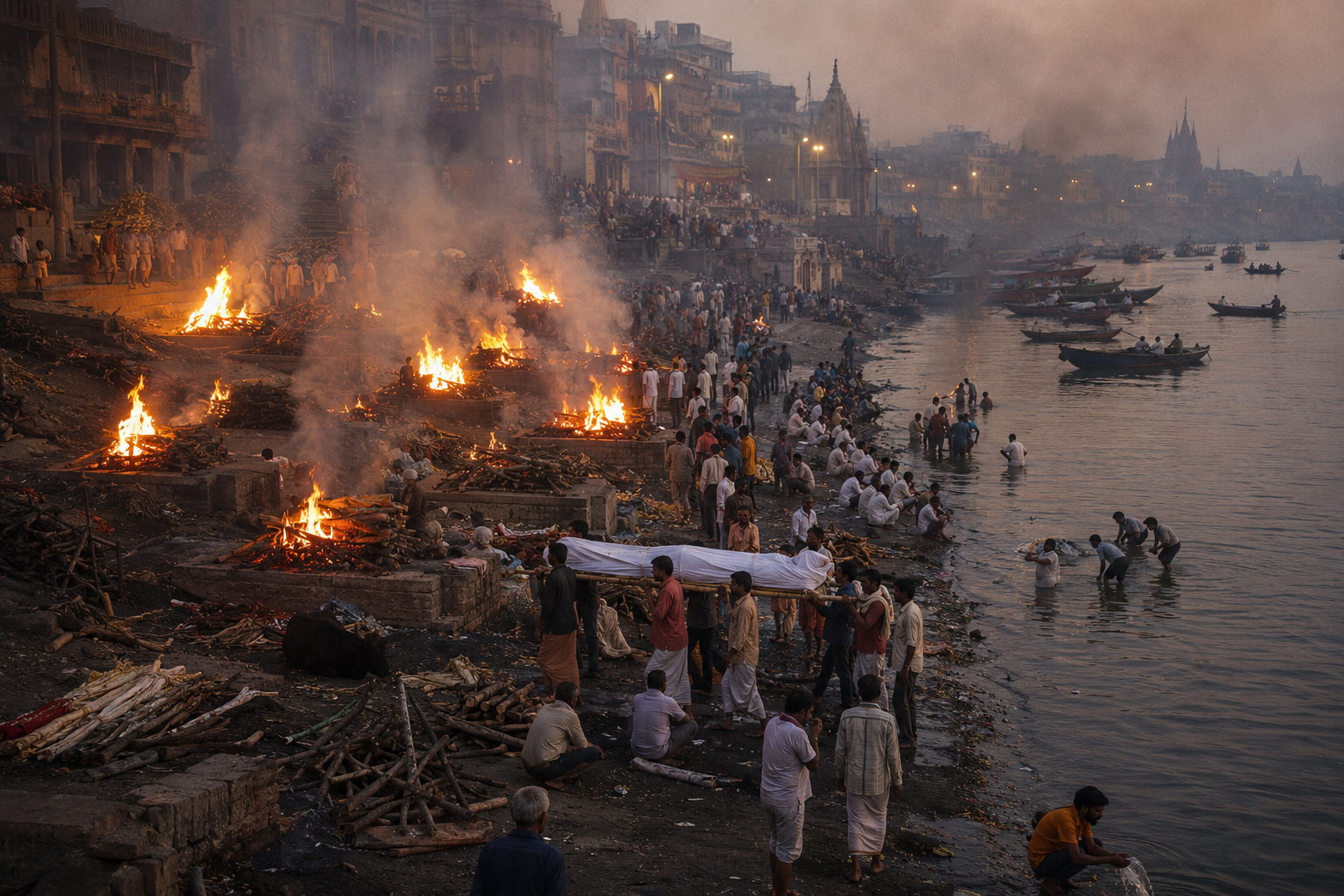
Benares, — a city where the dead come to escape.

Dying to Disappear
Night Train to Benares
I was lying on the floor of a night train from Delhi to Benares (now Varanasi). No seat, no ticket. The queue for third-class tickets had been too much. This was 1973, and I was travelling rough as I could to make my money last.
When the inspector passed, I pretended to sleep — and he let me be. But a middle-aged woman – obviously without a ticket also – in a frayed sari wasn’t having it. From the corner of my eye, I saw her pointing furiously at me, shouting at the inspector. I didn’t understand Hindi, but I got the gist: Why not him?
The Road of the Dead
When the train runs along the roadside by the river Ganges you can already see, though still 100 km from Benares, bodies being carried on biers, made of bamboo poles, by young men jogging briskly along. Other young men follow to take the relay when needed. The bodies, wrapped in cotton dhotis, seem to dance to the rhythm of the movement. Tradition says the should be no more than 24 hours to cremation.
The Promise of Escape
Bringing a dead person so far needs a serious reward: it is simply the chance to escape. Cremation on the banks of the Ganges gives you a chance—in Hindu belief—of being united with the God‑head, the spark of life that you are returns to the eternal flame—breaking the cycle of reincarnation. As life, specially at that time, in India was a brutal struggle for most people it made sense that many did not fancy coming back.
The prospect of countless returns, karma deciding which slot you occupy among many possibilities, from insect to celebrity, takes some shine off the glamour of rebirth. Obviously, there must also be the danger of coming back and not being recognised. Can you imagine the situation where is somebody comes back as a chicken, he’s not recognised and he’s eaten by his family. It is clear that, speaking, logically that is possible.
City of the Living, City of the Dead
Benares may be a city for the living but above all it’s a city for the dead. All roads lead to the sacred river as to Mecca. Of course, the river is not just a cremation site, it is also for ablutions for the lucky ones. Evidently, many of the people for morning ablutions have come here to die—the fulfilment of a lifelong wish. The fact that the waters are filthy seems to matter little. Believers drink it, confidently – because as it is sacred it cannot do harm.
Descent Toward the Ghats
As you approach the Ghats—the steps down to the river, the streets are narrow, dark and lined with wood shops. Shopkeepers are weighing logs of wood on large scales and there is much bargaining. It takes about 300kg to burn a body; the rich buy sandalwood, the poor mango wood and often not enough. You step aside when chanting approaches; there is a continual movement of jogging biers carrying shrouded figures rushing through. The burning incense placed on each corner of the bier is bright in the gloom.
Bedlam Before the River
Children who want to act as guides accost: “Me show you burning place”, is a constant wail. On doorsteps women are selling petals threaded on string: garlands for the biers. The scene is of noisy bedlam: bearers chanting, women selling, shopkeepers shouting prices, children pleading.
The Smell of the Ghats
As you approach the river the smell of spices, burning joss sticks and sandalwood gives way to the smell of burning flesh. You step out of the town, the houses appearing to overhang the Ghats in places, onto the top step and the burning pyres meet your eyes…and nose.
The Pyres
There are twenty pyres burning and there is a queue. Those arriving bring the shrouded figure to the river, immerse it in the water, splash water on the covered face and squat by the bier to wait their turn.
Heavy logs on the bottom, lighter ones on top of the body. No women here: the nearest male relative leads the rites. Circling the bier relatives chanting, he adds ghee (clarified butter) to the pyre and others add powder.
Ashes to the Ganges
Burnt‑out pyres are swept up and the ashes and, at times, an occasional charred limb—not enough money to buy enough wood —are consigned with little ceremony to the muddy fast‑flowing waters. Sacred cows and dogs circle the pyres: the cows trying to snatch at the garlands which are put aside, dogs at the end as the ashes and remains are heaved into the water. The sacred cows are gently shooed away, the mangy dogs viciously kicked at.
Back Towards the Living
I head back to town to the clang of temple bells and the spicy comfort of cooking fires – cooking anything and everything eatable apart from the meat of the sacred, spoiled and arrogant cow.
I ponder on what I have seen. If I described it to friends, they would probably not be shocked but find it strange that I wanted to see it. But, I am curious, it is why I travel – to see the ways of the world. If I had a choice in choosing my rebirth, I would be happy to come as myself: maybe an egotistical wish. KARMA rules!