Category: Posts

  • Postcards from Paris

    Postcards from Paris

    Paris has a languorous air in August. Indeed, half of the city is on holidays and the other half relaxes. This is Thursday morning and the temperature is expected to rise to 40° today. Dangerous times for us elderly people. I usually get up between 6:00 and 7:00 and at that time it’s very quiet very little traffic. On Monday and Thursday mornings the first sounds are normally workers setting up market stalls For the open air markets on Tuesdays and Fridays. The sounds are metal on metal and workers shouting to each other and on sunny mornings like this, joking. I hear But don’t understand. The languages I hear mainly are Arabic from the Maghreb and African dialects.

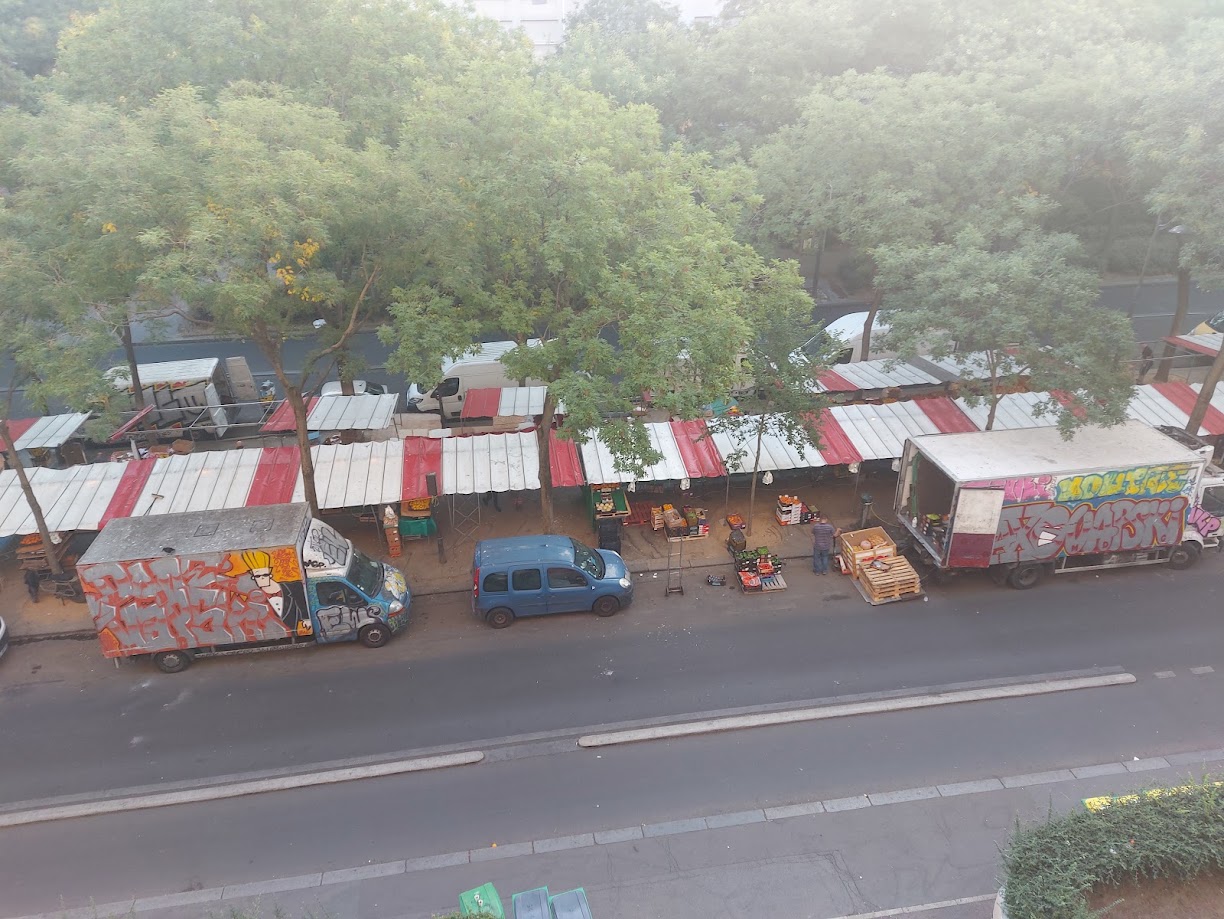
    I live on a wide boulevard, it has a wide central walkway with trees and benches and is used for the market twice a week. It goes from early to about 1.30 pm. The market is an important one, it is about a mile long. It’s mainly fruit, vegetables, some clothes, some household articles. It’s a very cheap market. But you have to be it careful of the quality. It is quiet also at the moment, and some of the stall places are vacant. I like Paris in August, it’s my favourite month. I’m just back from Madagascar, after seven weeks on the West Coast but strangely enough, it’s hotter in Paris than it was there.

    14 th August

    Some people said they enjoyed the postcard I put up yesterday, so here’s another one from this morning.

    Got up about 7:00, made a cup of tea, and sat out on my balcony to watch the people setting up the market—all men—putting out their wares for the day. It’s quiet at that time, except for the birds. It’s the only day of the week, apart from Tuesday, that the gulls come by; they visit early to see what they can scavenge before and after the shoppers.

    There’s an obvious pecking order among the birds: gulls at the top, then crows, pigeons, and finally sparrows. Earlier in the spring, before the lime trees were heavily leafed, bunches of starlings used them to roost. I even saw a murmuration one late afternoon, though I think they were chased away pretty quickly by the crows.

    This is a photo I took around 7:30. I wasn’t able to finish my breakfast on the balcony because it had already grown too hot to sit outside by 8:00. Yesterday it hit 39°C, though today is supposed to be a bit cooler.

    Enjoy the day!

    Paris has a languorous air in August. Indeed, half of the city is on holidays and the other half relaxes. This is Thursday morning and the temperature is expected to rise to 40° today. Dangerous times for us elderly people. I usually get up between 6:00 and 7:00 and at that time it’s very quiet very little traffic. On Monday and Thursday mornings the first sounds are normally workers setting up market stalls For the open air markets on Tuesdays and Fridays. The sounds are metal on metal and workers shouting to each other and on sunny mornings like this, joking. I hear But don’t understand. The languages I hear mainly are Arabic from the Maghreb and African dialects.

    I live on a wide boulevard, it has a wide central walkway with trees and benches and is used for the market twice a week. It goes from early to about 1.30 pm. The market is an important one, it is about a mile long. It’s mainly fruit, vegetables, some clothes, some household articles. It’s a very cheap market. But you have to be it careful of the quality. It is quiet also at the moment, and some of the stall places are vacant. I like Paris in August, it’s my favourite month. I’m just back from Madagascar, after seven weeks on the West Coast but strangely enough, it’s hotter in Paris than it was there.

    14 th August

    Some people said they enjoyed the postcard I put up yesterday, so here’s another one fro

  • The Oldest Person in the World

    The Oldest Person in the World

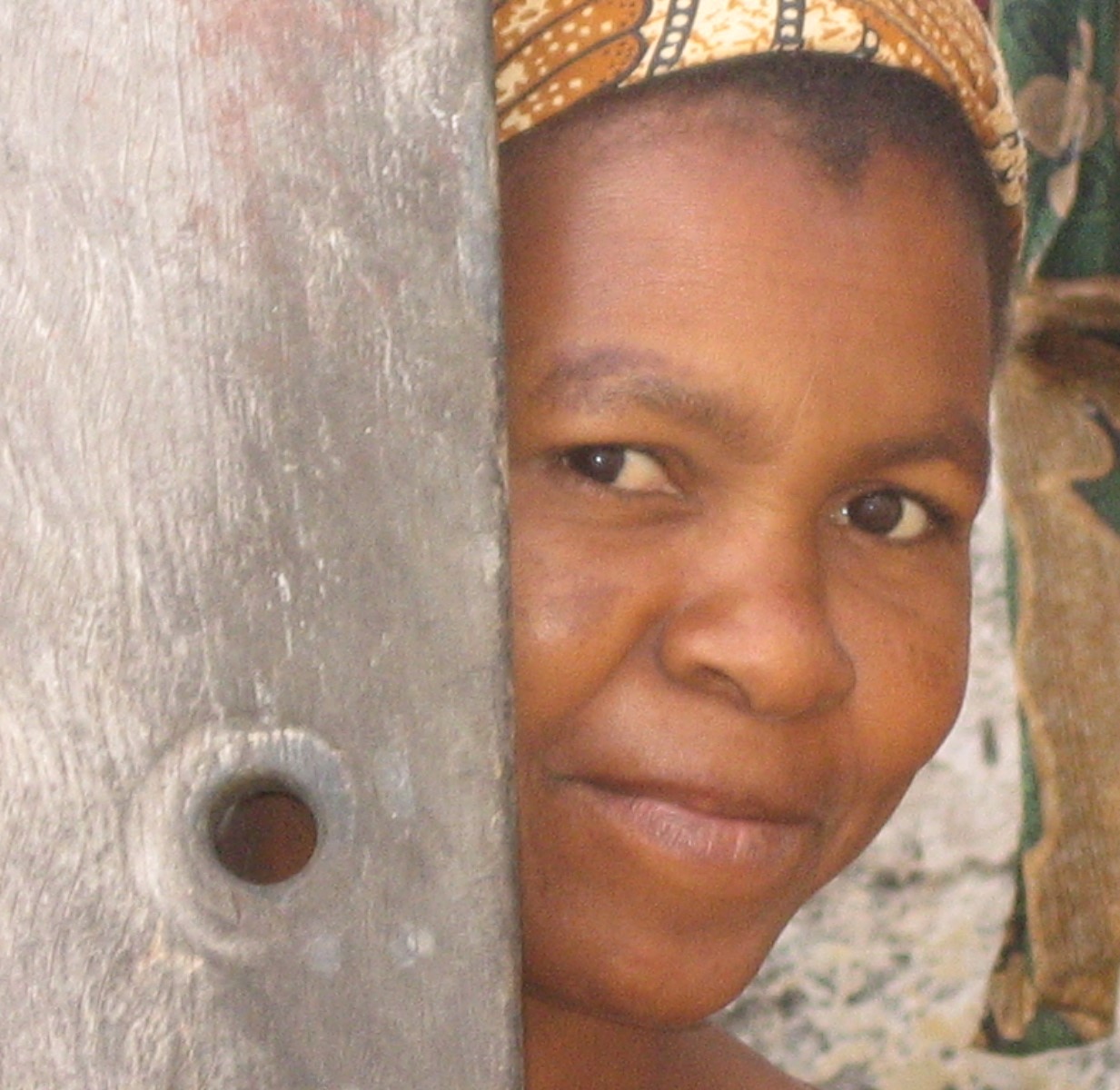
    I am quite sure that for a certain time she was the oldest person (116) in the world. She died in 2021. These photos was taken in 2020 about six months before she died. She lived in a tiny rural village in Madagascar: no paved roads, no electricity, no running water, no medical services. She was, however, surrounded by family.

    There was a birth certificate, issued under the French administration, I did not see it, but my friend – her great, great granddaughter did. It was held by the lady’s nephew who lived beside her. The reason I believe her is that when I wanted to make her situation known, she refused, not wanting any publicity – absolutely no reason to lie.

    She lived in a most basic hut in a small village in North-West Madagascar. She never saw the inside of a hospital.

    Her most modest house
  • The Meaning of Life: Andre Brink

    The Meaning of Life: Andre Brink

    I bought the book at Johannesburg airport. The blurb said, “A writer at the top of his craft. I’ve often wondered when a craft becomes art, in any case André Brink’s book called, Before I Forget is superbly written. It is a thinly veiled autobiography, the writer does not use his own name in the book, maybe it could be called a selective memoir.

     It is his attempt to isolate the determining influences in his life; in his case, these all happen to be women. Not only do they have a determining influence on his life, but it is through them, and particularly through his sexual relations with them, that he attempts to get to some type of truth, about life itself and how to make sense of something that is, with our limited capacity, meaningless.

    It is a continual frustration, the need to attach some importance, beyond the biological wish to stay alive, to something which, no matter how we look at it, can be termed meaningless. Of course, religion may help people. Many religions describe the importance of individual life to God but, possibly, one needs to be very imaginative or just lazy to want to have the fantastic mystery of life packaged in such, very often, ridiculous stories.

    Brink suggests that the sexual act and the moment of ‘going outside of himself’ in that most sensual of moments – that moment of total exchange , is the closest one might get to knowing a kind of truth about oneself and what it is to be human.

    J.M. Coetzee his friend and contemporary took a took a diametrically opposite point of view

  • The Knife Sharpener

    The Knife Sharpener

    The Knife Sharpener

    She was sharpening her knives on the edge of the concrete pavement. I was having a beer in her little ‘gargotte’. A gargotte is the Malagasy name for a very informal restaurant.

    When I asked her what she was doing, she replied – with a smile, “Sharpening the knives for the next revolution.”

    She made this remark immediately after the young-peoples’ riots in Antananarivo which toppled the government – once again – in Madagascar.

    The Malagasy people have generally a poor level of education – not their fault- but an extremely high level of cynicism about everybody with a little authority;

  • Children Working

    Children Working


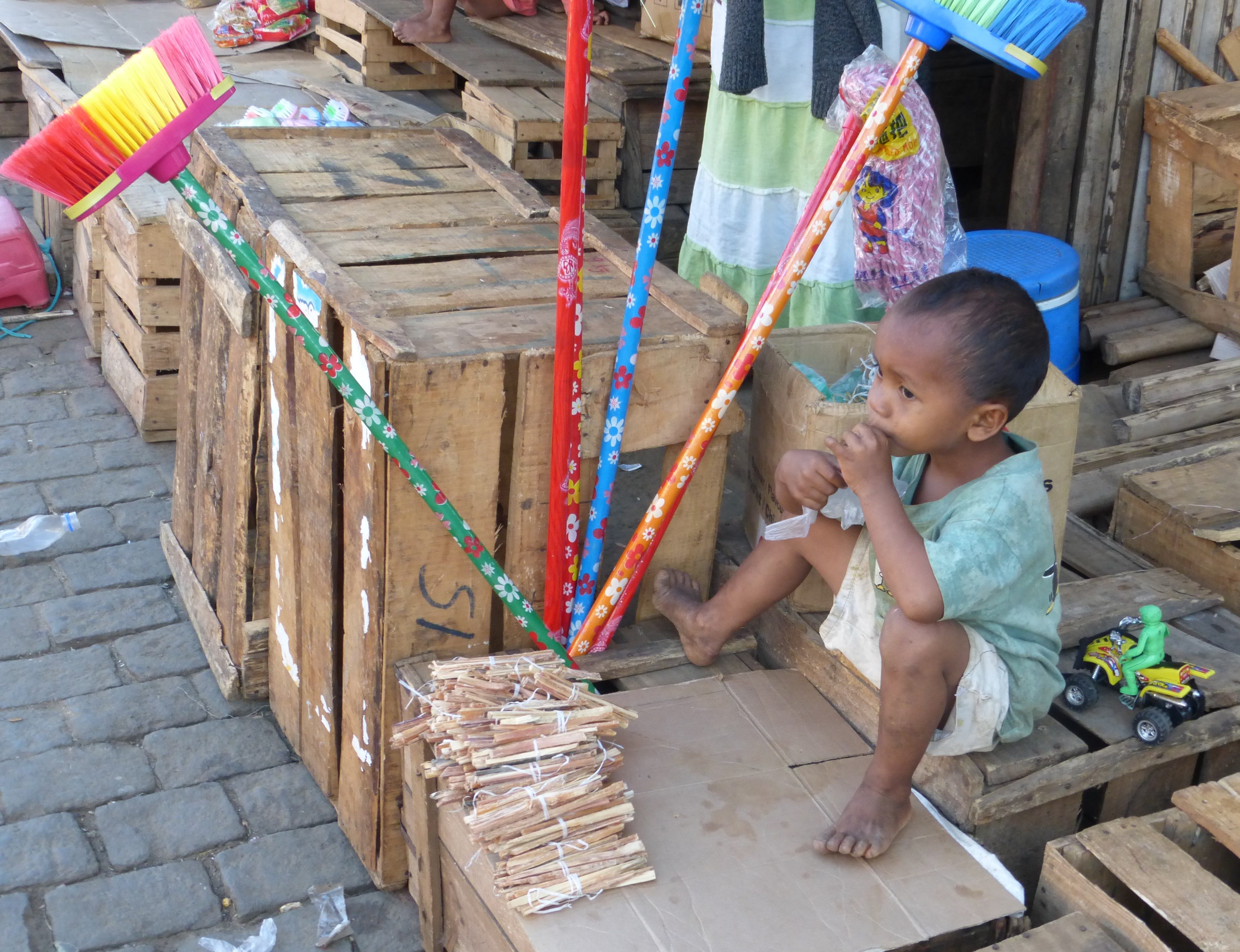
    In a market in Madagascar, a child sits with bundles of ‘kitay’ — small sticks, sold for a few cents to kindle the family cooking fire


    In a market in northern Madagascar, I took a photo of a young boy sitting among crates and bundles – and his toy. He can’t have been more than 4 or 5 but already doing business – helping his family.

    In front were neat stacks of sticks tied with twine. I asked what they were but he didn’t speak any French and I didn’t have enough Malagasy to understand him when he tried to explain. Was he old enough to go to school? Again I didn’t understand his answer – I think he said, “sometimes” but I wasn’t sure.

    I bought a bundle for 500 ariary – about 15 cents and he gave me a smile.

    I guessed they were medicinal barks — something to chew or brew into a tonic, maybe even katrafay, the tree bark so often sold for its healing powers.

    I was wrong.

    A Malagasy friend later told me : it was simply kitay — kindling wood. Sold for a few cents, just enough to light the cooking fire.

    The photo tells another story too: In Madagascar, as in much of Africa, the gap between generations is small. The young start early, helping their parents, doing their share of daily tasks — for better or worse. Childhood and doing tasks go together in Africa. Maybe it explains the easy natural relations which seem to exist with adults – family or otherwise.

    About 44% of children in Madagascar aged 5–14 are working, and over 90% of those work in agriculture, mostly for rural families. They mainly work in the areas of planting and harvesting vanilla and rice. But they also work in mining cleaning marketplaces, begging, and scavenging garbage. Also, at times before the age of 14 they are exploited sexually particularly in tourist areas.

    A little over 80% of Malagasies live in extreme poverty and using children – another pair of hands – is one of the results. More than 40 % of children do not attend school regularly, another result.

    It’s an unfair world