
I leave Ambilobe early next morning. There are mountains rising on both sides and fading into the distance like pale silhouettes. The landscapes are spectacular on this part of the run. There also is an early freshness but the sun is already large and will soon be brash.

Shaded stretches of road promise a moment of coolness, but I am wary. They often hide sudden potholes – some resembling small craters. When one appears without warning too late to avoid, I grit my teeth and tighten my grip on the handlebars.
A bridge ahead has been badly damaged by the recent cyclone, but the diversion is simple this time. I ride upstream and find a shallow ford to cross.

After six months away, it feels wonderful to be back on the bike, the wind brushing my face like a warm caress. I keep the visor down, though — it limits the view and dulls the sensation, but it’s safer.
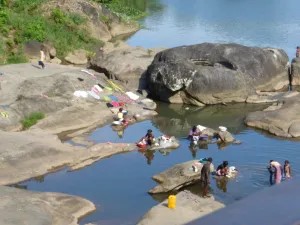
I observe, with pleasure, early morning activities: women washing clothes in a river, young men shepherding zebus to pastures from the safety of nighttime stockades, kids going to school, people, many barefoot, going to market.
Approaching Ambanja
Ambanja lies ahead. I’ve never much liked the town, though the surrounding countryside is magnificent.

The main artery from North to South, the single narrow tarmac street has no sidewalks and is clogged all day with people walking, bicycles, tuk‑tuks, rickshaws, cars, and heavy lorries. Vendors occupy the edges, forcing pedestrians into the road. Noise, dust, and fumes hang in the air from dawn to late. Before reaching town, I turn right toward Ankify, the port for boats to Nosy Be — the island’s main tourist spot, with its international airport. I hope to see Das, a hotel handyman who I’ve fished with a couple of times.
The road winds through vast plantations of cacao — the raw material of chocolate — and through fields of vanilla, ylang‑ylang, wild pepper, and pineapples. It is Madagascar’s most fertile region.
A Common but Painful Reality

Then I come upon a scene that is sadly common here.
Families, including small children, are breaking stones by the roadside. Young men tackle the largest rocks; the pieces are passed down to older people and children, who chip away at the smallest fragments.
I’ve seen it many times, but it always saddens me. In rural areas, children who break stones often do not attend school. Poverty is stark: according to the World Bank, 80% of the population lives in extreme poverty.
I don’t find Das, but I leave him a note to make a fishing rdv and a little cash. Then I turn back toward Ambanja and its crowded main street.
A Beer, and a Moral Maze
After checking into a small hotel and taking a cold shower, I sit with a beer on the terrace of a local bar. Nearby, two elderly Frenchmen are talking.
Many foreign residents here live on modest pensions, drawn by the low cost of living — and by companionship. The men watch girls passing by, speaking of them as if they were commodities.

One remarks, “If you looked at a girl like that in France, she might call the police.” His friend, more familiar with local life, replies, “They don’t mind, you can even touch them. And now you can negotiate the price — there are few tourists.”
Many girls in one of the world’s poorest countries face difficult choices. Most of those seen with older white men are not prostitutes. They would love to marry but in the meantime… They may need money for a baby, a dress, food for their family, or a mother’s birthday. A chance appears, and they take it. There is a certain social tolerance for this.
The portlier of the two men nods toward a nearby table, they are speaking French. “See that young one? She’s just come from the countryside. She’s with her cousin. I know the cousin. She’s the one to have — she’s new. She knows nothing.”
They invite the two girls to join them. The older girl speaks confidently; the younger looks timid, almost frightened, like a bird ready to flee. When spoken to, she stammers a few words. She clearly has little French.
She won’t fly away. She will probably learn some French and how to navigate her new situation. It is a charade, but the masculine impulse to believe oneself still attractive to young women remains strong for a long time.
Understanding the Context
I lived and worked in sub‑Saharan Africa for fourteen years. I am no sociologist, but I listen, look, and try to understand. Attitudes toward love and sex differ from Western norms. Knowing the context, I have learned to be less judgmental than many people from the rich North.
The girls at the table are typical Malagasy girls in many ways — relatively honest, regular church‑ or mosque‑goers, fiercely loyal to their families. Many will have a child by their late teens or early twenties. A child is much more important than a husband. A child with a French resident or even a tourist is like winning the lottery. When I attempt to describe the situation to friends back in the west, they throw up their arms in despair, sighing and exclaiming: “poor girls, so hard, having to prostitute themselves like that, so sad. And they resume discussing where to go on their next holiday or some such matter. They who normally, have never been hungry a day in their lives.
Sometimes I suggest that these girls seem a lot happier than them, their rich Western counterparts, they feel I am just mocking.
Easy attitudes to sex in Sub-Saharan Africa long predate missionaries or tourism. Sex is neither seen as taboo or a romantic search for a soulmate but as a natural part of life — no circling around the subject. Generally there is little or no dating or ‘going out’ or getting drunk before consumation. Maybe it is not seen as a necessity like food or shelter, but still seen as one of life’s essential tastes: the idea of celibacy being seen as unnatural.
I sip my beer slowly and ponder the different ways to look at life.

.